5. Preburst
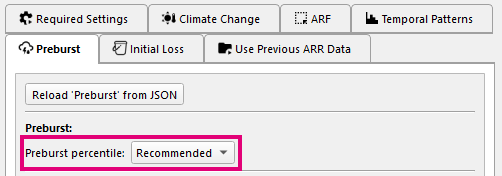
5.1 Preburst Percentile
This option sets the preburst percentile to derive the preburst depths from.
The preburst depths are used in both complete storms and design burst only events.
- complete storm: used for the rainfall depth in the preburst pattern
- design burst only storms: used to calculate the burst initial loss: \(IL_{burst} = IL_{storm} - PB_{depth}\)
The "recommended" option will use the recommended preburst percentile(s) from the ARR Data Hub if they are provided, otherwise it will fallback to using the 50th percentile.
For example, catchments in NSW may receive a recommended preburst table from the ARR Data Hub (which mixes 50th and 75th percentiles). However, many regions won't receive a recommended preburst table, and the 50th percentile will be used.
The "recommended" preburst will not always be the jurisdiction recommended prebursts
When the ARR Data Hub does not provide a "recommended" preburst table, the tool falls back to the 50th percentile.
The fallback is always the 50th percentile and is not guaranteed to be the recommended percentile for any given jurisdiction. The 50th percentile is a reasonable fallback for most regions, however it is up to the user to choose an appropriate value for the given jurisdiction.
5.2 Complete Storms
A complete storm prepends a preburst rainfall period ahead of the ARR design burst, so the full storm initial loss can be used rather than a burst initial loss.
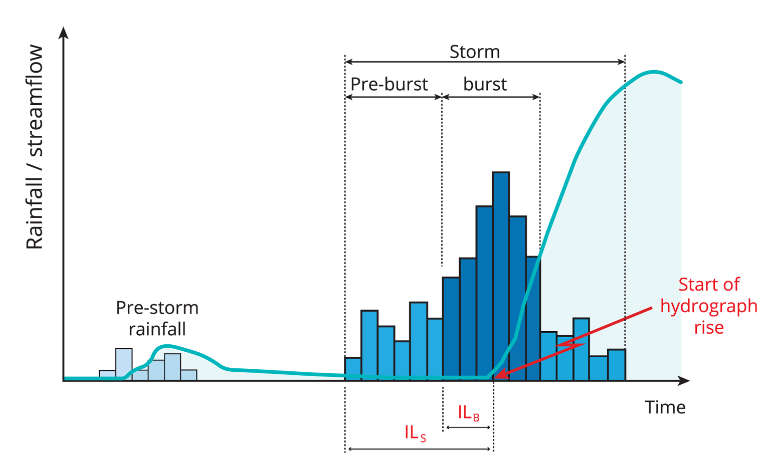
(Source: ARR Book 5, Chapter 3, Figure 5.3.5)
The tool will automatically switch to using a complete storm for events where \(PB_{depth} > IL_{storm}\) (i.e. the burst initial loss is calculated to be less than zero).
This is triggered for individual events i.e. if a complete storm is triggered for the 1% AEP 60 min event, this will not trigger complete storms for other events if they are not required.
- Complete storm: checking this box will force complete storms for every event. If unchecked, complete storms will trigger automatically for events that require it (unless the preburst pattern method is "None" - see next point below).
- Complete storms can be turned off completely (no automatic switching) by setting the Preburst pattern method to "None".
5.2.1 Preburst Pattern Methods
-
Recommended:
The "recommended" method will use the provided preburst temporal pattern if one is provided by the ARR Data Hub. If the ARR Data Hub does not provide preburst temporal patterns, then the recommended method will fallback to the Temporal Pattern Method (see below).
The "recommended" method may not always be appropriate
If the ARR Data Hub does not provide preburst temporal patterns, the fallback method is to the use the Temporal Pattern Method.
The ARR guideline does not make any specific recommendations on how to formulate preburst temporal patterns, as such the chosen fallback method in the tool is not something that is explicitly recommended in the guideline.
It is up to the user to determine what an appropriate method is for their location, particularly if the ARR Data Hub does not provide preburst temporal pattern data.
-
Constant:
The "Constant" method applies the preburst rainfall depth equally, at a constant rate, over a given time period. See the 5.2.2 Preburst Duration section for more information on how to set the preburst duration.
-
Temporal Pattern:
The "Temporal Pattern" method uses a point temporal pattern from the burst temporal pattern data downloaded from the ARR Data Hub. The rarity band of the preburst temporal pattern will match the burst event rarity.
- Temporal Pattern: The user can select which temporal pattern number to use for the preburst. Selecting "Design burst" will use the same temporal number as the design burst temporal pattern.
See the 5.2.2 Preburst Duration section below for more information on how to set the preburst duration.
-
None:
The "None" method turns off complete storms entirely. The burst initial loss will be set to zero in instances where the complete storm would have been triggered normally.
5.2.2 Preburst Duration
If the Preburst temporal pattern method is set to either the "Constant" or "Temporal Pattern" method, the preburst duration is determined by either:
- Setting the Preburst duration (hrs) - this will be applied to all events, regardless of the burst duration.
-
Using Proportional duration - this sets the preburst duration to be proportional to the burst duration.
A maximum preburst duration is also in effect and can be changed by the user. This prevents long events (> 72 hrs) from blowing out due to long preburst durations.
When using the Temporal Pattern Method, the closest temporal pattern duration is used (rounded up if equidistance between durations).
5.2.3 Other Notes / Assumptions
5.2.3.1 Negligible Preburst Assumption
If the resulting preburst depth turns out to be less than 1% of the point design burst depth (implied preburst ratio < 0.01), the preburst period is dropped entirely and the event falls back to a standard burst-only event.
5.2.3.2 Requested Durations Fall Between a "Use PB TP" Cell and a Fixed-value Cell
If a requested duration falls between two rows of the burst initial loss table where one is numeric and the other is the "Use PB TP" placeholder (only applicable when the preburst temporal patterns are provided by the ARR Data Hub), a straight linear interpolation between them wouldn't make sense (a placeholder isn't a loss value).
Instead, the tool calculates the burst initial loss, using (interpolated) preburst depths and storm initial loss. If the result is positive, it's used directly (no complete storm needed); if it is negative, the cell is treated as "Use PB TP", automatically triggering complete storm assembly for that specific AEP/duration. A duration bracketed by two "Use PB TP" cells is likewise treated as "Use PB TP" (no numeric neighbour exists to derive anything from).