6. Initial Loss
6.1 Burst Initial Loss Method
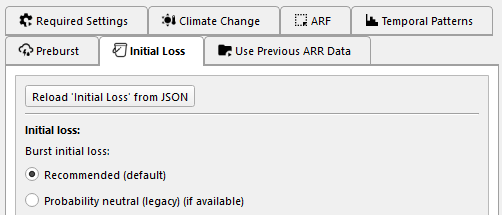
This option sets which initial loss table is retrieved from the ARR Data Hub for design burst events:
-
Recommended (default): use the ARR Data Hub's standard/recommended storm initial loss table and calculate the burst loss:
\[ IL_{burst} = IL_{storm} - PB_{depth} \]For the majority of catchments, the ARR Data Hub provides a single "Storm Initial Loss" value. Catchments in NSW may retrieve an AEP independent loss table.
-
Probability neutral (legacy) (if available): use the ARR Data Hub's "probability neutral" initial loss table, where available (typically only available for NSW catchments).
6.2 Short Duration Extrapolation Method
This option sets how the burst initial loss is extrapolated for durations shorter than those directly provided by the ARR Data Hub (< 30 minutes). The available methods are:
- Interpolate to zero: the losses are interpolated using the assumption that at the zero minute duration, the initial loss is zero.
- Log-interpolate to zero: the same as the Interpolate to zero option but it uses a log scale for duration (uses a boundary value of zero for zero minutes).
- Interpolate pre-burst: the preburst depths are interpolated using the assumption that at the zero minute duration, the preburst depth is zero.
- Log-interpolate pre-burst: same as Interpolate pre-burst option but uses a log scale for duration (uses a boundary value of zero for zero minutes).
- Constant: the burst initial loss is held constant from the nearest table row edge. This matches the method named "Use 60 min loss" in the ARR to TUFLOW (legacy) tool.
- Constant pre-burst ratio (default): the preburst ratio is held constant from the nearest table row/column edge.
- Rahman et al. 2002: an equation from a study conducted by Rahman et al 2002 is used.
- Hill et al. 1996/1998 (requires MAR): an equation from a study conducted by Hill et al 1996:1998 is used. This requires the user to set the Mean annual rainfall (MAR) (mm) input.
- Static value (requires static loss): the loss value is defined by a user input and will be used for all the extrapolated values. The method requires the user to set the static_loss value.
6.3 TUFLOW Loss Method
Sets how the initial/continuing loss values are written to the TUFLOW model inputs:
-
Infiltration (soil file): losses are written to a
.tsoilfsoils file. The infiltration approach does not support automatically setting up impervious losses (impervious areas are landcover, and not a soil type). Fraction impervious can be setup in thematerials.csvto account for impervious areas. -
Rainfall excess (material file): losses are written as a rainfall excess initial/continuing loss to a materials file.
Optionally, Fixed impervious/urban area initial and continuing losses can also be specified and will write an entry into the
materials.csv.
6.4 User Overrides
The calculated initial loss and/or continuing loss values can be overridden with user-specified values:
-
Initial loss (mm): overrides the Storm Initial Loss with a single user-specified value.
-
Continuing loss (mm/hr): overrides the continuing loss with a single user-specified value.
6.5 Outputs
There are 2 output files associated with the loss values, dependent on which TUFLOW Loss Method was used:
rainfall_losses.trd/soil_infiltration.trd: these files contain the loss values and sets them to a variable based on the storm event. The files are identical, but the naming convention is based on the chosen TUFLOW Loss Method.soils.tsoilf(if using the Infiltration method): the soil definition file for use in the model.materials.csv(if using the Rainfall excess method): the material file that contains rainfall losses defined.
6.6 Working data
The calculated burst initial loss is output to the working_data folder. The placeholder "Use PB TP" (use preburst temporal pattern) is used
if a complete storm is triggered (burst initial loss is no longer used).
6.7 Other Notes / Assumptions
- For missing internal values, the burst initial loss is calculated by interpolating the rainfall and preburst ratios separately and calculating the preburst depth (rather than interpolating the preburst depths directly). Rainfall depths are not always required to be interpolated since there is more event information provided, but if it is interpolated it is done so using linear interpolation in log-log space. Preburst ratios use linear interpolation in log-linear space (duration and AEP use log space, the preburst value uses linear space).
- For missing external values, the values are extrapolated by holding the preburst ratio from the nearest column/row edge constant. The exception is for short duration extrapolation, which uses the 6.2 Short Duration Extrapolation Method setting.
- For complete storms, the Storm Initial Loss value is always used (either from the ARR Data Hub or the user specified value).